Millman Experience helps him retain Canadian title

image

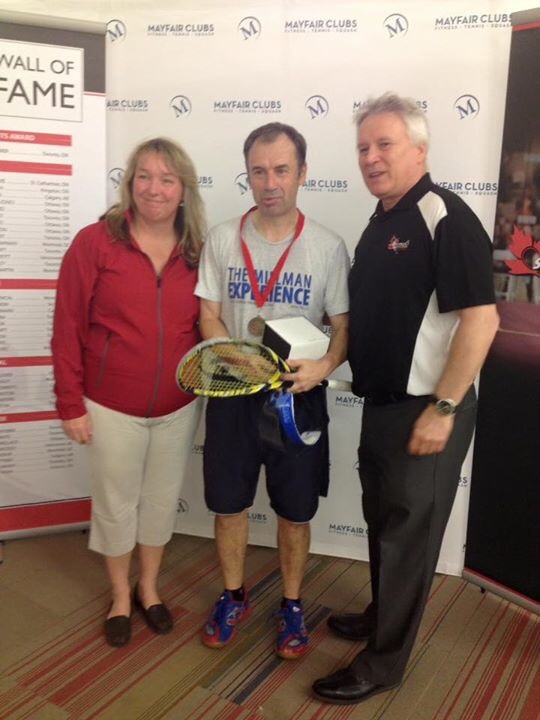
I was delighted to retain my Canadian National 55+ title today at Mayfair Athletic Club’s Lakeshore Blvd. location in Toronto this morning.

My opponent, no 2 seed Mike Blythe,played very well in the first game, coming back from 6/10 down to win the first game 12/10.

However after some calming words from my coach, I was able to right the ship and came through to win 3 games to one.

I would like to thank: my coach – my darling wife Pat Millman, my trainer Brian Elzey from Meadow Mill Athletic Club in Baltimore,my practice partner – Squashwise’s own Zach Bradley and my sponsors:
Imask Protective Eyewear (@imaskusa), my racquet and show sponsor – Harrow Sports (@harrowsports), my tart cherry juice and anti-inflammatory extraordinaire Cheribundi (@cheribundi).

Roll on the World Masters in Johannesburg South Africa!

World Masters Squash Preparation

Hi folks,
I am in the process of trying to put together a plan for the World Masters in Johannesburg SA this September.
I need to know if there are players from the USA and Canada that might be interested in an altitude training camp with me in Salt Lake City this September – whether or not you intend to go to Johannesburg.
The program would be 6 days of boot camp including intensive coaching/training with me, plus matchplay against local players.
Please message me right away if you are interested in this camp.
best
Richard

The Millman Experiencers and Coach Millman roll on at the US National Masters

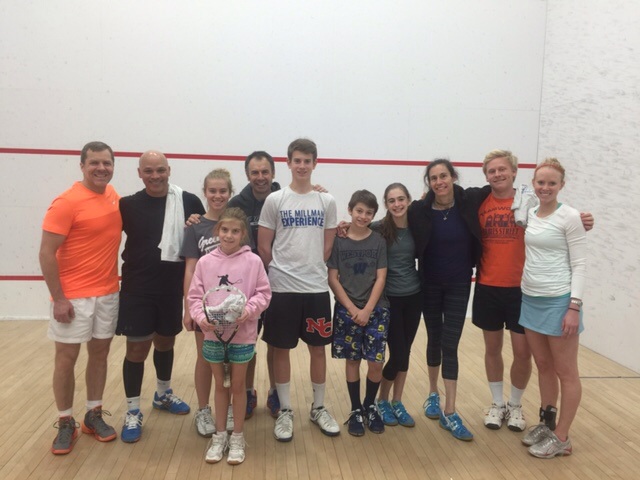
Millman Experiencers at US Nationals.
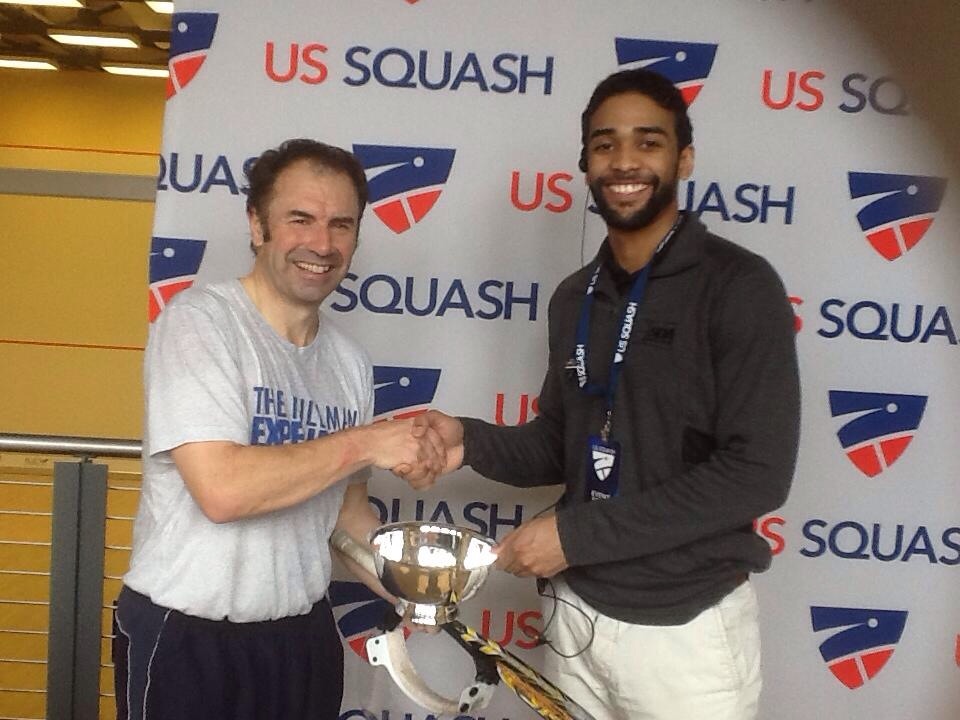
Richard Millman US National 55+ Champion 2016!
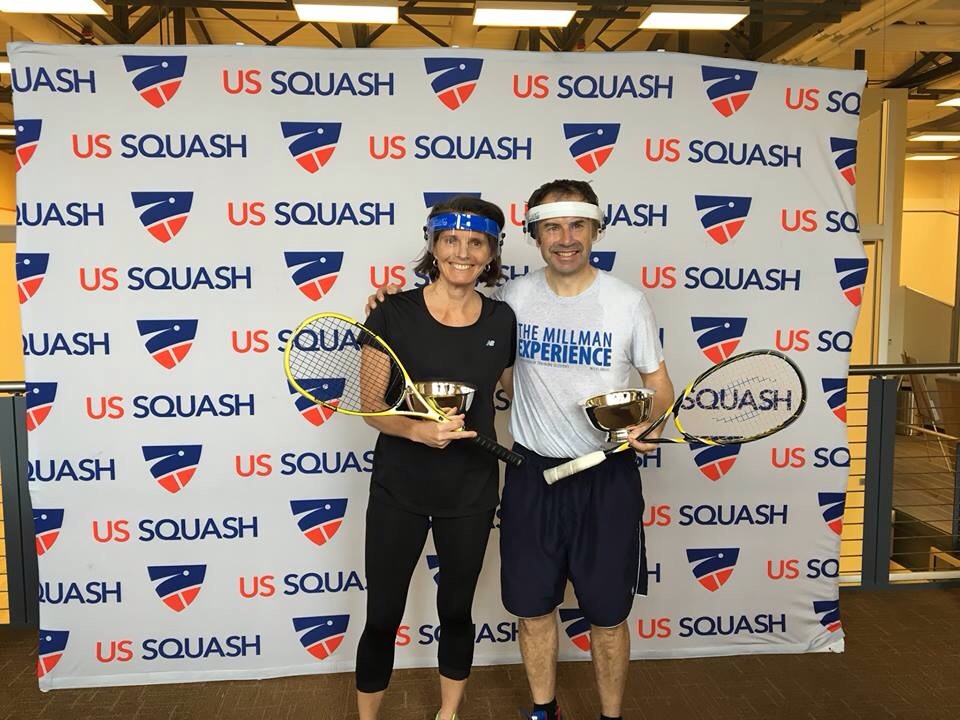
Hope Nichols Prockop and Richard Millman sporting their Imask and their 2016 National Champions Trophies!

Wonderful weekend for the Millman Experience…….

Coaching is a very full life and at times extremely demanding.

But every once in a while the fruits of both the coach’s and the student’s labors offer sweet rewards.

Such was the case for me this weekend.

Simultaneously I was running a Millman Experience training weekend in The Research Triangle area of North Carolina, while one of my leading students and his teammates that I had had the privilege of working with for a week earlier this season were competing in the Hoehn ( B) division of the Collegiate Squash Association’s national team champs and also while many of my junior students were competing in the Mid Atlantic Regional Championships.

As you can imagine one can feel almost schizophrenic with so many invested interests.

Fortunately my Gemini birth sign helps me divide myself effectively and -Wow! what a wonderful weekend!

First I personally had a most fulfilling weekend with my Millman Experience group – all of whom visibly progressed over the weekend and went away apparently highly enthused to continue their development.

Next I had a wonderful text from my friend and student David Cromwell telling me that despite losing their no 1 player to Mono and he having had to step up to the number one spot, his Middlebury college team had wrested a famous victory today against Brown University – he himself winning in the fifth and his team mates demonstrating the team work and camaraderie that both I and their excellent coach Mark Lewis had encouraged them to build.

More music to the old coach’s ears.

Finally I received not one but multiple messages from the group of junior students that I am fortunate enough to work with at Meadow Mill Athletic Club in Baltimore.

I am delighted to say that all my students whether winners or losers seem to have performed extremely well at the Mid Atantic Regional junior champs at Meadow Mill this weekend .

I am proud of all of those that I am lucky enough to work with and I also share those congratulations with some of the other Meadow Mill coaches who work with these players.

Special mention to my students

Ben Korn -mid  Atlantic Regional U19 boys champion

Cullen Little – mid Atlantic Regional  U17 boys finalist

Rohan Korn – mid Atlantic Regional U15 boys Champion

Isaac Mitchell – mid Atlantic Regional U13 boys Champion.

As I said – all my players seemingly have stepped up and used the training that we have done together successfully this weekend – but for the four boys mentioned above – this is a wonderful and memorable milestone in their development.
The winning is frankly a bonus – the meat on the bones is that they focused not on the result but on the way they played and in performing got the result they deserved.

I know their will be many more weekends of mixed feelings and even disappointment.

But this weekend everything came together!

Yahoo!!!!

Millman Experience 2/13 and 14 at St Luke’s New Canaan

imageJust a quick note to thank all those that participated in the latest edition of the Millman Experience last weekend at St Luke’s School New Canaan, CT.
Particular thanks to Jen Gabler for pulling it together and to Brian Mathias for hosting us at St Lukes.
The group was a wonderful team – who gelled particularly well and contributed to each other’s learning process perfectly. Well done everyone!

Philosophy, Analysis, Practicality, Strategy and Execution in Squash. A five part series by Richard Millman. Part 2: Analysis

Phlilosophy, analysis, practicality, strategy and execution in Squash.
A five part series, by Richard Millman.

Part 2. Analysis

As I said in the first of this series of five articles, the central pillar and most important priority in the game of Squash, and indeed in the struggle for life itself, is survival.

This powerful and apparently simple principle, is much less than simple to adhere to, however. In the complex application of behaviors that we see in Squash, the essential principle of life and death is often forgotten and is eclipsed by behaviors that should be being used to survive but, for various reasons, are given such focus and attention, that they improperly take on a life of their own and receive undue or misplaced attention – ultimately to the detriment of their original essential purpose.

In order to develop as a Squash player it is essential to clearly analyze and clearly understand the capacities required to survive, without becoming sidetracked.

In the battle for life, ultimate survival is a punishing razor’s edge where complacency or mis-judgement, over-confidence or loss of focus, have only one outcome:
Death.

Since time immemorial, human beings have been engaged in the battle for survival against other species and against our own species.

Whichever it was against, two key traits were and are required in order to succeed, overcome and survive. These two traits are as true today as they were a million years ago or however long ago it was that our ancestors first fought to survive.

These two traits work in combination, are as important as each other, are interdependent, but must never be confused or used as substitutes for one another.

The first can be termed ‘Primary focus.’

Primary focus is used to ‘attend’ to a human being’s most immediate and urgent matters at hand (more on the much mistaken concept of attention in a later part of this series).

In primeval times it may have been used to follow the spoor or trail of prey, or to attend to a Grizzly bear that suddenly confronted you, or a hostile member of our own species who was attacking.

On the Squash court Primary Focus is concerned with the ball.
Only the ball.

The second of these essential traits that work in concert for our survival can be termed ‘Peripheral Awareness.’

Peripheral Awareness is used to continuously scan your surroundings and the environment around which a human being’s most immediate and urgent matter at hand is transpiring.

In primeval times it may have been the forest around the trail you were tracking to ensure that you didn’t step on a dry twig and give your presence away or break your ankle stepping into a gopher hole, it may have been detailed awareness of the immediate area in order to escape or trap the Grizzly bear confronting you, it may have been knowledge of the obstacles around you and your attacker as you fought for survival – to ensure that you didn’t lose your footing or have your ability to maneuver thwarted.

On the Squash court Peripheral Awareness is concerned with everything except the ball.
It is what we use to continuously be intimately familiar with the entire court and our place within it.
It is what we use to continuously be aware of our opponent’s position, their options,the angles of possibility of those options and the best location from which to equilaterally defend the court against the specific options of that moment.
It is what we use to continuously be aware of imminent happenings such as the opponent imminently hitting the ball or the ball imminently hitting the nick or ourselves imminently running into a wall or our opponent or their racquet.
It is what we use in the process known as Hand/Eye coordination – a vastly useful tool that humans use in the survival process, not just to strike a moving object, but to judge the intersection of any moving objects – and that with a level of accuracy that is as extraordinary as it is microscopic.

It is what we use in an inextricable partnership with our Primary Focus to attempt to avoid death.

These two then, are the tools of human survival and success.

We use them to manage the commodity of survival.

But what is the commodity of survival?

That which a surfeit of means life and a lack thereof turns us into slaves and even leads to death?

It is non other than Time itself.
That monstrous, slippery, never-ending, fickle, resource.

The dance of life and death wherein human beings have used the two vital perception systems that I have described, Primary Focus and Peripheral Awareness, in order to lethally manage Time, is as old as mankind and as paramount today as it was then and all the days between.

It was and is still the difference between you and the Tiger’s jaws, between you releasing your arrow and the Antelope escaping, between your swerving body and your opponent’s sword tip or your sword tip and their body, and in Squash between you and the ball being struck by your opponent and then bouncing twice and between your opponent and you striking the ball and it bouncing twice.

It is a minuscule amount of time that when marginally increased by stealing it from your opponent or expanding it through management of your actions, can make you feel enormously powerful; conversely that minuscule amount of time can be rapidly lost by loss of focus or poor decisions or by incapacity and suddenly you are the most miserable pauper in the world.

Survival is determined by your capacity to balance time in your favor. But that balancing act is performed on a razors edge and unless you have analyzed just precisely what is required to survive and prepared yourself to be able to practically do so, disaster awaits you.

The tools at your disposal: Primary Focus and Peripheral Awareness.

The task you must perform with those tools: The management of the time between you and the ball being struck and bouncing twice.

The prize: Survival – in the face of the opponent’s efforts to do so.

But how do we practically manage time? What are the necessary assets and skills required to effectively manage these tools that we have carefully analyzed? And what are the pitfalls?

In my next article I will discuss the Practicality of Survival.

Richard Millman
1/13/16

The Millman Experience weekend club program

IMG_0164Are you a club, school or college that is interested in being at the forefront of development and entertainment in Squash?Continue reading “The Millman Experience weekend club program”

Philosophy, Analysis, Practicality, Strategy and Execution in Squash. A five part series by Richard Millman. Part 1: Philosophy

Phlilosophy, analysis, practicality, strategy and execution in Squash.A five part series, by Richard Millman.
Part 1. Philosophy

As I write, that extraordinary railway terminus in New York, Grand Central Station, and more particularly the wonderful Vanderbilt Hall, is once again echoing with the ‘thud,’ ‘thud,’ ‘thud,’ of a rubber ball against glass walls.
For those of us that are lifelong addicts, this is both the source of pride and frustration.
Pride, in that the whole world walks through Grand Central and sees the best that our game has to offer, and frustration in that neither we nor they have the capacity to instantly understand the complexity of what is happening.
To the casual observer, the spectacular ‘cockpit’ enclosing two pretty fit looking athletes is a momentary distraction, perhaps even the subject of a few minutes of novel fascination. But, after a while the number of variables become simply too much to absorb and the passer-by moves on to something that he or she is more familiar with.
If it was an NFL game or and NBA game, observers both casual and expert would have a shared general understanding of roughly what was happening. But in Squash, not only do the casual and expert observers not share a basic understanding of what is happening, the experts themselves are still trying to understand what is going on. Such is the complexity of our sport.
To the lifelong addict such as myself, these games are the source of amazement, as young people and the people around them, wholly dedicated to a pursuit that has limited financial rewards ( and those only at the very top of the game), push themselves past any perceivable limitations in the search for survival and success.
Ultimately those two – survival and success – are interchangeable.
In the same way that the cockerel that survived in the bloody onslaught of the historical cockpit, was successful.
In a fight for life and death between two combatants, survival is success and vice-versa.
That is the simple and pure philosophy of Squash.
Whether you are a passer-by at Grand Central or one of the leading experts in the game, it is imperative that you look at Squash through the ‘lens’ of survival, if you hope to gain an understanding.
But to understand how to survive requires detailed analysis and comprehension of the physical, mental, technical, emotional and strategic aspects of that survival.
And that study is a maelstrom of widely diverging opinion often backed by powerful, charming, charismatic, famous, forceful, experienced personalities, but rarely (if ever) by logical, empirical study.
Expert opinion is only that – opinion. And too often that opinion is accepted as fact. Our sport needs firmer ground than opinion alone as a foundation. We must be able to hold our understanding up to the candle of proof.

Opinion without facts is like a house built on sand.
Squash needs more than that if it is to reach its maximum success, indeed if it is to fight for its own survival.
In my next piece, I will look at the analysis required to accurately identify and highlight the unbelievably complex kaleidoscope of behaviors that are required for a Squash player to ultimately survive.
Hopefully accurate analysis will make the subtleties of Squash more accessible both to folks who happen upon our sport as they wander through Vanderbilt Hall, and to those who wish to expose themselves to the ultimate challenge of the life and death fight for survival in the arena.
Richard Millman

1/10/16


The Millman Experience

The Millman Experience
  I’m here at the US Junior Open coaching several of my up and coming students.

Between coaching assignations, I have been watching the other games and today I hit on something that may be of interest to you.

It was certainly interesting to me.
The quality of play here continues to escalate; technically, strategically, physically – although understandably the emotional state of young athletes, fighting for their place in the pecking order of life, continues to be a bit wobbly – as does some of the behavior of coaches and parents who are also desperate for them to succeed – although even that seems less animated this year.
But within the confines of that superior play, I have noticed some interesting trends.
Depending on how experienced you are, you may or may not know that most players start off playing squash with much more confidence in their forehand strokes than in their backhands.
However if and when they become experienced and advanced players their backhands become their better sides. 
This has to do with the fact that the natural forehand stroke is a pulling and throwing action that, if overdone, tends to lead to the ball being pulled away from the sidewall, whereas the backhand action is more of a directed, uncoiling action, that is easier to push along the wall away from the body as opposed to the ball being pulled across the body.
However, I believe the degree to which the backhand becomes unduly focused upon has a number of other contributory factors.
For one, few dynamic young players can resist the opportunity of ripping a hard forehand when the opportunity arises. As a consequence, attention to forehand length directional control and pace variation is a rare attribute in young squash players. 
Here at the US Junior Open, players that set up and float tight balls down the forehand side are in a small minority – whereas they almost all do that exceptionally well on their backhands.
There are other reasons too, for this strong desire to rip the forehand toward the opponent’s backhand. 
Most players and coaches when working at beginner/intermediate level focus on playing the ball to the opponent’s weaker backhand.
Hence Mark Allen’s email handle ‘ Lobtohisbackhand.’
But once players reach a level of proficiency in returning deep backhands, I wonder if this love affair with attacking the deep backhand actually becomes a hangover that is much less productive and is actually destructive, in so far as it discourages the development of quality, controlled, forehand play?
I had the pleasure of chatting about this today, with that great doyen of French and World Squash, Thierry Lincou – now the Head Coach at MIT.
I posited the following theory to him:
Left handed players develop in a different environment to right hand players ( there being less of them) and necessarily learn to rally on their forehand sides against the consistency of the right handed backhand.
In my experience, lefties don’t rip their forehands anywhere near as much as righties ( they get less opportunity and it is much riskier against the tight righty backhand).
However they do have similar backhand development for the same mechanical reasons I mentioned earlier.
On the other hand lefties don’t get as much exposure to patient careful backhand rallies as righties do – because the righties can’t resist ripping their forehands most of the time. Perhaps the lefty’s backhand makes the righty a little more disciplined, but to be honest, I think most righties – unless they have really trained on this specifically – can’t free themselves from the rush of adrenaline they feel when they get the chance to crack the ball, from half or three-quarter length. This usually means the righty doesn’t get forward to intercept on the volley as often on the forehand as they do on the backhand, because they don’t consider/manufacture the time they need to get forward when they rip a forehand.
So here’s a thought from this old coach:
What if we made sure that our righty players regularly trained with either lefties of their own level or above, or with a lefty pro?
Would this increase the quality of control and pace that righty players developed and discourage the desire to just whack the ball on the forehand?
Thierry thought about it for a moment and then relayed his strategy when he was a player, when playing lefties.
He told me that he would always build a backhand game plan against Peter Nicol or Amr Shabana based on hitting to the backhand deep.
He said that the reason for this was that he knew that they were confident on the forehand side but less so on the backhand and that he could usually get an opening.
I find this very interesting.
At first blush, one could be forgiven for thinking that Thierry was positing the old ‘Lobtohisbackhand’ strategy – until you stop and remember that in Nicol and Shabana we are talking about two of the greats of out game. They didn’t have technical flaws like some Under 13 boy or girl.
No.


What I believe Thierry had struck upon was how much practice Nicol and Shabana had in competition, playing deep on their backhand sides.
Clearly it was more than in junior competition, because James Wilstrop and Nick Matthew don’t just rip it when it comes to their forehands, but even so, I suspect that the time that they spent deep on their backhand sides was appreciably less that deep on their forehand sides.
So, as a result of this discussion and my continuing observations, I have to conclude that if we wish to see the continuing development of quality in junior squash, planning regular training with lefties is a must if righties are to bring the quality of their forehand organization, execution and pace control up to or close to the level of their backhands.
Of course if we do that, Thierry won’t be able to get so much mileage out of playing deep to the lefty backhand – because the lefties will improve too.
Which is of course good for us all, because everyone and Squash as a community, will step up another notch in this ever evolving game.
Oh and by the way, could all the lefty coaches that find their business increasing after this article please forward my 10% commission check via Pay Pal?
Thanks.
Richard Millman

December 20th 2015

At the US Junior Open at Trinity College, Hartford, CT. 

E Pluribus Unum – Squash style

E Pluribus Unum
The whole is greater than the sum of the parts, or so the saying goes.
But of course, each whole is greater still if the the parts are great to begin with.
Such is the case in American Squash today in my view, with still greater prospects looking forward.
The strong traditions and talent pool of the oldest organized squash country in the world, its adherence to the values of meritocracy and its willingness to embrace any individual that can make a positive contribution and the unique supply and demand market of college squash, have produced the ultimate melting pot of both US and international squash talent.
The melting pot, inevitably, is a swirling mixture of confusion; but every once in a while, the USA’s ability to act as a catalyst takes disparate personalities and combines them with situations and opportunities to create an individual whose unique assets may never have come to the fore in the same way, without having been thrown into this extraordinarily fertile environment.
Such an individual, in my opinion, is a young Englishman from Yorkshire, whose gentle manner, quiet voice and loose limbed appearance belie a remarkable fire within.
His name is Luke Butterworth.
Once upon a time my wife Pat and I contributed to the development of the squash mecca that the Westchester County, New York and nearby Fairfield County, Connecticut have become.
Into this firepit the young and unassuming Luke Butterworth arrived. He made his way first to the well respected squash program at the Round Hill Club under the mentorship of Steve Scharff.
This in itself was providential as Scharff is not dissimilar in nature to Luke Butterworth.
Extremely courteous and gentle of manner, he was himself a ferocious competitor who expressed his courage and vitality exceptionally well on the Squash court.
Additionally Luke was able to call upon a number of good friends that he had developed strong links with in his brief but successful career on the World Squash tour.
I well remember him dropping into Westchester Squash to train with his friend Andy Learoyd and also my surprise when the seemingly gentle youth produced such clinical, searing precision and effortless movement on the court.
With the strong platform and mentorship of Steve Scharff and the Round Hill, Luke proceeded to diligently go about the business of turning his undoubted prowess as a player into a celebrated ability as a coach and mentor.
In all of my interactions with him I have found him to be considerate. I mean deeply considerate – in all senses of the word.
This is an essential quality in our sport. The ability to accurately consider the future consequences of one’s action and then rapidly adjust the immediate action to take account of possible outcomes is a rare skill.
The ability to pass this understanding on, with clear concise explanation, is rarer still.
And yet, without doubt, Luke Butterworth, in his inimitable way, has achieved just this.
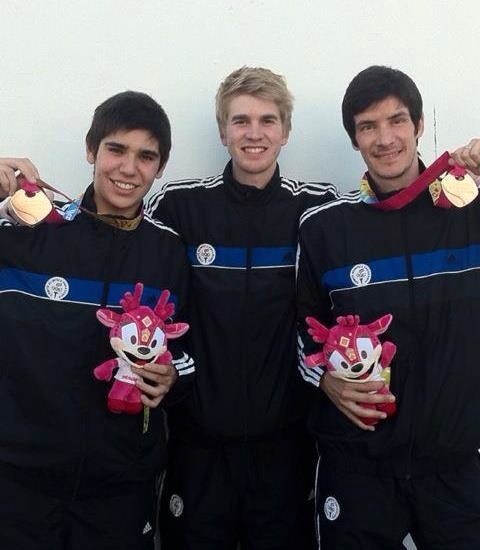
Having gleaned a great deal from Steve Scharff, Luke was encouraged to spread his wings and did so, gaining an appointment as the national coach of Paraguay for the 2011 Pan American games – where with his help, the Paraguayan’s achieved an unprecedented Bronze Medal.

Understandably, his Paraguayan team are full of praise for the young Master.
More recently Luke has moved on to the prestigious Greenwich Academy for Girls, a program of unparalleled historic success on the squash court and an institution that would not make squash appointments lightly.
In addition, in recognition of his world class talent as a Squash coach, US Squash has seen fit to make Luke a part of their national coaching framework where he heads up the the regional program of arguably the strongest US region in Connecticut.
Here are a couple of quotes from those who Luke’s work has materially affected:
Esteban Casarino 21 time Paraguayan Champion and PSA world number 90:
“Leading to the Panam Games that year, I aproached our National association’s president, as our team # 1 and said that if we wanted to have a chance for the podium we had to bring somenone who could take the weight of been the coach from my shoulders and we explain that to our National Olympic Comittee as well. (-)
The results, Bronze medal at the 2011 Panam Games, showed we were right. A great achievement by a great team.”
Steve Scharff – Head Professional of the Round Hill Club:
“Luke was a major part of the recent success of the junior squash program at the Round Hill Club. He helped establish a culture inclusive of all squash players but also pushed the truly interested ones to reach new heights. With Luke’s help, the program produced multiple players ranked #1 in the U.S. from 2011-2014.”
Rich Wade – Director of National Teams US Squash:
“‘It is very rare to have a player of Luke’s playing ability on the world stage also be able to harness those skills with coaching and delivering those messages to other players. During his time in the U.S., Luke has proven to be a valuable addition and US Squash have no doubt that he will continue to be one of the very best coaches in the country.”

Clearly Luke Butterworth is a rare and world class talent. His development continues and with it the progress of the United States in this truly modern sport that combines intellect, physical fitness, courage, wit and dedication.
Survival is the number one priority of the Human kind and Squash helps our species to hone its survival skills in the modern world where the comfort of a protected society often leads to the loss of those necessary skills.
We in the United States are fortunate to be able to call upon the riches of the global talent pool to help our students of the game, young and old, to continue the pursuit of excellence in this complex world.
The global talent pool in its turn recognizes that there is no better environment in which to ply its trade.
Thus our whole is becoming greater as we source the sum of greater parts.
And one of those that we may count ourselves fortunate to have garnered is Luke Butterworth.

Richard Millman Dec 17th, 1995

USOC Developmental Squash Coach of the Year 2014

First ever Pan American US Men’s Squash Coach – Mar Del Plata, Argentina, 1995